
Amazon Web Services (AWS) is a leading cloud platform globally, offering arguably the broadest set of cloud products and services across compute, storage, networking, machine learning, security, and more. Its early entry, continuous expansion, and innovation have earned it a dominant position among public cloud providers. Professionals in fields like IT, finance, consulting, and technology-driven industries must understand AWS because many businesses migrate to cloud infrastructures, rely on AWS for digital transformation, big data analytics, AI services, disaster recovery and global operations.
In this article, we will cover what AWS is, why it matters in today’s digital economy, its core components, popular services, pricing models, and challenges to consider.
What is AWS?
Amazon Web Services (AWS) is a cloud computing platform offered by Amazon. It provides on-demand computing resources, storage, and other services via the internet, allowing individuals and organisations to provision virtual servers, databases, and more without owning physical hardware.
Launched in 2006, AWS initially offered services such as Amazon S3 (storage) and EC2 (Elastic Compute Cloud). Over the years, it has expanded to over 200 fully featured services globally. Its infrastructure spans many geographic regions and availability zones, enabling high availability, low latency, and redundancy.
Globally, AWS leads market share in cloud infrastructure, often cited ahead of competitors in both revenue and service breadth. In regions such as South Africa (with data centres in Cape Town), AWS has become particularly relevant as local latency, compliance, data sovereignty, and cloud adoption grow.
Read more on AWS Cloud Computing Certification – Benefits & Careers here

Why AWS Matters in Today’s Digital Economy
AWS has become a critical driver of modern business innovation and efficiency. Its cloud platform allows organisations to optimise costs, scale operations dynamically, and adopt advanced technologies such as AI, machine learning, and big data analytics. As companies increasingly migrate workloads to the cloud, demand for skilled AWS professionals continues to grow.
- Cost savings via pay-as-you-go model – Instead of large capital expenditure on servers and data centres, companies pay only for what they use, such as compute hours, storage size, data transfer, etc.
- Flexibility and scalability – AWS allows rapid scaling up or down based on demand (for example, handling traffic peaks), enabling businesses of all sizes to adapt without over-investment.
- Digital transformation, big data and AI – Many organisations are adopting AI, machine learning, and data analytics. AWS offers tools and services (e.g. SageMaker, Athena, Kinesis) that facilitate large-scale data processing, predictive analytics, and ML model deployment.
- Growing demand for AWS-certified professionals – Businesses need staff who can architect, secure, manage and optimise cloud infrastructure on AWS. Roles such as Cloud Engineer, DevOps Engineer, Cloud Architect, and Cloud Security Specialist are in increasing demand globally and locally.
Read more on What is Economies of Scale in Cloud Computing? here
Core Components of AWS
Understanding the core components of Amazon Web Services (AWS) is fundamental for anyone pursuing a career in cloud computing or managing cloud infrastructure. AWS is designed as a modular platform, offering a variety of services that cater to compute, storage, databases, networking, security, and identity management.
Each of these building blocks serves a specific purpose, enabling organisations to design scalable, secure, and cost-effective cloud solutions. One of the best ways of learning more about AWS and the various opportunities it provides is by enrolling for the Digital Regeneys IITPSA-accredited Cloud Computing and DevOps Course with AI/ML.
Listed below are some of the core components of AWS:
- Compute – Services like EC2, Lambda, and Elastic Beanstalk provide the processing power to run applications, from virtual servers to serverless code, without managing physical hardware.
- Storage – S3 stores any type of file at scale, EBS gives fast storage for virtual servers, and Glacier offers very low-cost storage for backups and archives.
- Databases – RDS manages popular relational databases, DynamoDB handles fast NoSQL workloads, and Redshift is a data warehouse for analysing large datasets.
- Networking & Content Delivery – VPC creates private networks, CloudFront speeds up content delivery worldwide, and Route 53 manages domains and directs traffic.
- Security & Identity – IAM controls who can access resources, KMS manages encryption keys, and tools like CloudTrail track activity for security and compliance.
Read more on What Are the Benefits of Cloud Computing for Businesses and Individuals? here

Popular AWS Services for Businesses
In addition to its core offerings, AWS provides a broad range of services that help businesses innovate, optimise operations, and gain a competitive edge. These services extend beyond traditional computing and storage, enabling organisations to leverage AI, analytics, DevOps practices, and IoT capabilities effectively.
Listed below are some of the most popular services provided by AWS:
- AI & Machine Learning – AWS tools like SageMaker help build, train, and deploy machine learning models. Comprehend analyses text for sentiment and entities, while Rekognition detects faces and objects in images and videos.
- Analytics – Services such as Athena let you query S3 data with SQL without managing servers. EMR processes big data using Hadoop or Spark, and Kinesis handles real-time streaming data for immediate insights.
- DevOps Tools – AWS supports modern development workflows with CodePipeline for CI/CD automation, CloudFormation for managing infrastructure as code, and container orchestration using Docker, Kubernetes, and Terraform.
- IoT Services – AWS IoT Core connects devices securely to the cloud, and Device Management helps register, organise, and manage large fleets of IoT devices remotely.
AWS Pricing Model and Cost Management
Managing costs effectively is a crucial aspect of working with AWS, both for organisations and professionals responsible for cloud strategy or operational oversight. AWS’s pricing model is designed to provide flexibility, scalability, and financial predictability, but understanding its nuances is key to optimising spend.
Listed below are the pricing models available to businesses:
- Pay-as-you-go
AWS charges based on actual usage, meaning businesses pay only for the resources they consume, compute hours, storage capacity, or data transfer. This model removes the need for long-term commitments, allowing companies to scale up or down according to demand without unnecessary expenditure. - Free Tier and Trials
New users can take advantage of AWS’s free tier, which offers limited usage of services such as EC2, S3, and Lambda. This is ideal for experimentation, testing workloads, or gaining practical experience without incurring costs, providing a safe environment to learn and validate solutions. - Cost Management Tools
AWS provides a suite of tools to monitor and control expenses effectively. Cost Explorer visualises usage and spending trends, Budgets set alerts for thresholds, billing dashboards track ongoing costs, and resource tagging enables cost allocation to specific projects or departments. - Practical Considerations for Businesses and Consultants
Proper cost management is more than monitoring expenses. It involves selecting the right instance types, storage tiers, and services for specific workloads, avoiding idle resources, and planning for seasonal or peak usage. These strategies directly impact profitability, operational efficiency, and the financial sustainability of cloud initiatives.
Read more on What is Saas in Cloud Computing? here
Conclusion
Amazon Web Services (AWS) has transformed how organisations approach IT infrastructure, providing a flexible, scalable, and secure cloud environment. From core compute, storage, and networking to advanced AI, analytics, DevOps, and IoT services, AWS empowers businesses to innovate and optimise operations. Its pay‑as‑you‑go pricing model, coupled with extensive cost management tools, ensures efficiency while reducing capital expenditure.
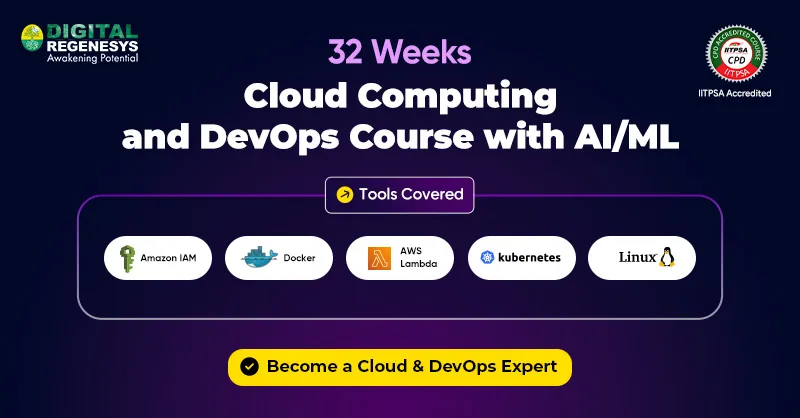
To gain practical skills and career-ready expertise, the Digital Regenesys Cloud Computing and DevOps Course with AI/ML provides hands-on projects, guided learning, and advanced modules on AWS, DevOps, and AI/ML deployment. It is designed for professionals seeking to transition into cloud roles or enhance their existing knowledge.
Visit the Digital Regenesys website and enrol for our course today!
Fundamentals of AWS – FAQs
What is AWS?
AWS is a comprehensive cloud platform offering compute, storage, networking, AI, analytics, and security services globally.
Why is AWS important for businesses?
It reduces capital expenditure, supports scalable operations, enables AI and analytics adoption, and fosters digital transformation.
What are the main AWS components?
Compute (EC2, Lambda), Storage (S3, EBS, Glacier), Databases (RDS, DynamoDB, Redshift), Networking (VPC, CloudFront, Route 53), Security (IAM, KMS).
Which AWS services are popular for AI/ML?
SageMaker, Comprehend, and Rekognition are widely used for machine learning and data insights.
What DevOps tools does AWS offer?
CodePipeline, CloudFormation, Docker, Kubernetes orchestration, and Terraform enable CI/CD and infrastructure automation.
Leave a Reply