
The demand for data scientists in the UK shows no signs of slowing down. Businesses, from fintech startups to multinational corporations, are seeking professionals who can transform raw data into actionable insights that drive informed decisions.
But while the opportunities are abundant, aspiring data scientists often wonder what to expect in terms of salary, career progression, and growth potential. This article provides a detailed look at data scientist salaries across entry-level, mid-level, and senior roles.
It also explores specialisations, shares tips for negotiating pay, and highlights ways to grow professionally while maintaining a balanced career.
Entry-Level / Junior Data Scientist
Junior data scientists typically support data collection, cleaning, and fundamental analysis. They work under supervision to prepare reports, run exploratory analyses, and assist in building simple predictive models. Essential skills include Python, R, SQL, and foundational statistics.
Problem-solving, attention to detail, and communication are key, as juniors often collaborate with more experienced team members. These roles are ideal for recent graduates or career switchers, providing practical exposure to real-world data challenges and learning opportunities.
Salaries for junior roles reflect these responsibilities and skills:
- Average salary: £34,741 as of September 2025
- Skills boosting pay: Python, SQL, data visualisation, basic machine learning

Mid-Level Data Scientist
Mid-level data scientists work independently on projects, often handling larger datasets and more complex models. They collaborate with business teams to interpret results and may mentor junior colleagues. Required skills include machine learning, advanced SQL, and data visualisation tools such as Tableau or Power BI.
Mid-level professionals often specialise in domains like finance, healthcare, or retail, which can increase their value. Practical experience and domain expertise become critical for promotion to senior roles.
Experience and specialised skills influence pay:
- Average salary: £53,027 as of September 2025
- Skills/certifications increasing pay: ML modelling, Python libraries, cloud platforms
Learn more about Data Science and Machine Learning.
Senior Data Scientist
Senior data scientists lead projects, develop advanced models, and provide strategic insights to stakeholders. They mentor mid-level and junior staff, manage pipelines, and ensure accurate interpretation of results for business decisions.
Expertise in AI, big data tools, and statistical modelling is crucial. Leadership, communication, and problem-solving skills are essential for guiding teams and shaping company strategies. Senior professionals may also influence organisational data policies and research priorities.
Senior roles reward expertise and leadership:
- Average salary: £91,472 as of July 2025
- Skills/certifications to maximise pay: AI/ML, big data platforms, project management
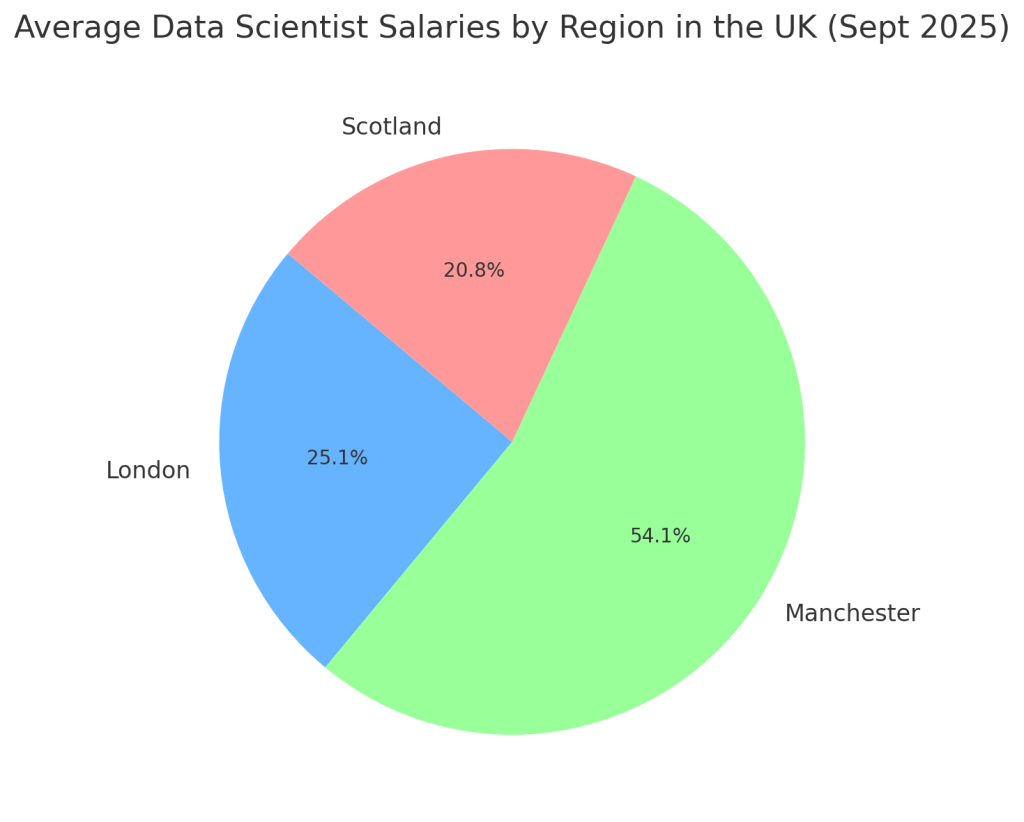
Regional Variations in Salary
Salaries differ significantly across the UK. London offers the highest pay due to its high living costs and concentration in the tech sector. Manchester, Edinburgh, and Birmingham are competitive but slightly lower in cost. Regional differences reflect local demand, industry presence, and company size. Professionals considering relocation should weigh higher salaries against the cost of living in the new location.
Regional salary examples:
- London average: £60,520 as of September 2025
- Manchester average: £130,400
- Scotland average: £50,228 as of September 2025
Factors Influencing Salary
Several factors shape data scientists’ pay. Experience level, education, and certifications are primary influencers. Advanced degrees or specialised certificates can boost credibility and open doors to higher-paying roles. Industry sector also matters; finance, technology, and healthcare typically offer premium compensation.
Location, company size, and demand for niche skills further affect salaries. Professionals can strategically plan career growth by understanding how these factors interplay and investing in skills that are in high demand.
Key factors influencing salaries:
- Experience level and years in the field
- Education and certifications
- Industry sector
- Location and demand for skills
Get insights on Fundamentals of Data Science.
Career Growth and Progression
Data scientists progress from junior roles to mid-level positions, then to senior roles, and eventually to lead or director positions. Promotion depends on skill development, project contributions, and the ability to influence strategic decisions. Professionals specialising in machine learning, AI, or big data often advance faster.
Leadership skills, mentoring, and business acumen further enhance career prospects. Planning a career path with targeted skill acquisition can accelerate growth and increase earning potential.
Tips for career progression:
- Typical promotion timeline: 2–5 years per level
- Upskill via certifications, advanced courses, and projects
- Target senior/lead roles to maximise salary
Data Scientist Specialisations and Their Impact on Salary
Specialising in a niche area of data science can significantly enhance both career growth and earning potential. Each specialisation focuses on distinct skills, ranging from building predictive models and designing AI applications to managing large-scale data pipelines.
Professionals with expertise in high-demand areas such as machine learning, AI, NLP, or data engineering are particularly sought after in sectors like finance, healthcare, and AI-driven tech startups.
The following table highlights popular data science specialisations, the key skills they require, their average UK salaries, and the potential impact on career progression:
|
Specialisation |
Key Skills |
Impact on Career |
|
Machine Learning Engineer |
Python, R, TensorFlow, Scikit-learn, Neural Networks |
High demand; opens roles in AI and predictive analytics |
|
Data Analyst |
SQL, Excel, Tableau, Power BI, Statistics |
Entry-level roles: gateway to more advanced data positions |
|
Data Engineer |
SQL, Python, Spark, ETL, Cloud Platforms |
Critical for data infrastructure; high growth potential |
|
Business Intelligence Analyst |
Power BI, Tableau, SQL, Data Visualisation |
Focused on insights for business decisions; moderately high demand |
|
Quantitative Analyst (Quant) |
Python, R, Statistics, Financial Modelling |
High-paying roles in finance, banking, and investment |
|
AI/Deep Learning Specialist |
TensorFlow, PyTorch, NLP, Computer Vision |
Cutting-edge roles; very high growth potential in the AI sector |
|
Data Science Manager |
Leadership, Project Management, Python, SQL |
Senior-level; combines technical and managerial responsibilities |
Know more about Is Data Science in Demand in South Africa?

Conclusion
Data science in the UK offers strong growth, rewarding salaries, and opportunities for strategic impact. Entry-level roles build foundational experience, mid-level positions involve autonomy and specialised work, and senior roles offer leadership and influence. Salaries are shaped by experience, location, industry, and specialisations.
For professionals seeking to accelerate their career and gain practical skills, the Digital Regenesys Data Science Certificate Course equips learners with hands-on experience in analytics, AI, and real-world data projects.
Visit Digital Regenesys to explore the Data Science Certificate Course and enhance your career potential.
Data Scientist Salary in the UK – FAQs
What qualifications are required to become a data scientist in the UK?
Degrees in computer science, mathematics, statistics, or related fields are common. Certifications and practical experience strengthen candidacy.
Can someone from a non-technical background enter data science?
Yes. Transitioning is possible with programming, statistics, and practical project experience gained through online courses or boot camps.
How important are coding and statistical skills?
Both are essential. Coding enables data manipulation and modelling, while statistics ensures accurate analysis and insights.
Which industries offer the best opportunities for data scientists?
Finance, tech, healthcare, retail, and emerging AI-driven sectors offer high demand and growth potential.
How can certifications help in career progression?
Certifications validate skills, demonstrate expertise, and can accelerate promotions while keeping professionals current with industry trends.
Leave a Reply