
Artificial Intelligence has become a transformative force in business and professional environments. From automating routine operations to providing insights that influence strategic decisions, AI is increasingly essential for maintaining competitiveness. Learning AI equips professionals and students with the knowledge to implement technology effectively, optimise processes, and remain relevant.
In this article, we will take a complete overview of online AI courses, including modules and outcomes.
Understanding Artificial Intelligence
Artificial Intelligence enables machines and systems to perform tasks that typically require human intelligence, such as problem-solving, learning, and language comprehension. AI integrates several subfields that are widely applied in professional environments.
Listed below are the various aspects of Artificial Intelligence:
- Machine Learning (ML) – Enables systems to learn from data, making predictions or informed decisions.
- Deep Learning – Uses neural networks to recognise complex patterns in large datasets.
- Natural Language Processing (NLP) – Enables machines to interpret and generate human language.
- Computer Vision – Allows systems to process and analyse images and video data.
AI is applied across multiple industries:
- Finance – Fraud detection, risk assessment, and predictive analytics.
- Healthcare – Diagnostics, patient monitoring, and research analysis.
- Marketing – Customer insights, personalised campaigns, and automation.
- Operations – Supply chain optimisation, predictive maintenance, and process automation.
Read more on How Artificial Intelligence is Shaping the Future of Work here
Who is Eligible for AI Courses?
Learning artificial intelligence (AI) is now accessible to a wide range of learners through structured courses. These courses are designed to build practical skills and open up career opportunities, although some require prior knowledge in subjects such as mathematics, coding, or data science.
Listed below are individuals who are eligible to enrol in an AI course:
1. Students and Graduates
Learners from diverse educational backgrounds can begin AI courses, particularly those interested in technology, problem-solving, or data analysis. Beginner-friendly programmes are designed to help anyone build a strong foundation.
2. Working Professionals
Professionals seeking to upskill or transition into tech-related roles can acquire practical knowledge and improve their career prospects through AI courses.
3. Career Switchers
Individuals from non-technical fields can start with introductory courses to learn key skills like programming, data handling, and machine learning basics.
4. Lifelong Learners
Anyone curious about AI, innovation, or technology can benefit, as many courses offer flexible learning and hands-on projects.
5. Entrepreneurs and Innovators
Business owners or innovators can use AI learning to make better decisions and create solutions that improve their ventures.
Learn more about: Can You Learn Artificial Intelligence Without Coding?
Types of Online AI Courses
Online AI courses vary in depth, focus, and duration, allowing learners to choose programmes that align with their experience level, career goals, and time availability. Some courses are specifically designed for beginners to build foundational skills, while others target experienced professionals seeking advanced knowledge and applied expertise.
Listed below are the various types of online courses that are available to learners:
- Short courses & certifications
- Duration – Under 1 year
- Focus – Practical, focused learning for beginners or skill refreshers
- Professional diplomas
- Duration – 6 – 12 months
- Focus – Structured curriculum with hands-on projects for learners with some prior experience
- Degree programmes
- Duration – 1 – 3 years
- Focus – Comprehensive study combining theory and applied knowledge for advanced learners
Short courses are ideal for beginners or professionals looking to acquire targeted AI skills quickly. Professional diplomas provide structured learning with practical applications for those with some prior knowledge. Degree programmes offer an in-depth theoretical and applied understanding for advanced learners.
The Digital Regenesys Certification Course in Artificial Intelligence is designed to accommodate all learners, from beginners to experienced professionals, in a progressive manner. The course builds foundational knowledge before advancing to practical projects and applied AI techniques, ensuring a clear learning pathway regardless of prior experience.
Core Topics Covered in AI Courses
AI courses are designed to give learners both theoretical understanding and practical experience, ensuring they can apply concepts in real-world scenarios. Through a structured curriculum, students develop coding skills, analytical capabilities, and applied knowledge in AI, preparing them for projects, problem-solving, and industry-relevant tasks.
- Programming for AI (Python & R) – Build coding skills to develop AI models and automate tasks.
- Machine Learning Techniques – Learn regression, classification, clustering, and predictive modelling for diverse applications.
- Data Analysis and Visualisation – Convert data into insights using graphs, dashboards, and analytics tools.
- Deep Learning & Neural Networks – Understand how AI recognises complex patterns in large datasets.
- Natural Language Processing & AI Ethics – Analyse text and language data responsibly and ethically.
- Practical Projects & Case Studies – Apply learning to real-world problems and build a portfolio of work.
Read more on What are the Best Jobs in Artificial Intelligence? here
How to Choose the Right AI Course?
Selecting the right AI course is crucial for achieving career goals and gaining practical skills. With programmes varying in depth, focus, and delivery, it is important to evaluate factors that ensure the course matches your experience level, learning style, and professional objectives.
Consider the following:
- Learning objectives – Select a course that aligns with your career aspirations and the specific skills you aim to develop, whether you are entering the AI field, upskilling, or advancing in your current role.
- Accreditation and credibility – Ensure industry standards recognise the course and come from a reputable provider, thereby enhancing the value of your certification in the job market.
- Practical versus theoretical focus – Hands-on projects and applied learning are essential if you want to implement AI skills immediately in professional settings.
- Flexibility and delivery format – Self-paced programmes allow learners to balance studies with work commitments, while instructor-led options provide structured guidance, mentorship, and scheduled assessments.
Career Opportunities After an AI Course
Completing an AI course opens doors to a wide range of career paths in South Africa across multiple industries. Learners acquire practical and applied knowledge that enables them to take up roles that require technical expertise, analytical thinking, and problem-solving.
Listed below are some roles that learners can explore depending on their competency and experience level:
- AI Analyst – Apply AI tools to analyse data, identify patterns, and support business decisions.
- Data Scientist – Transform raw data into actionable insights and predictive models for strategic planning.
- Machine Learning Engineer – Design and implement machine learning models to solve complex problems.
- AI Project Manager – Lead AI initiatives, coordinating technical teams and ensuring successful project delivery.
Read more on Artificial Intelligence in Social Media here
Challenges and How to Overcome Them
Learning AI can present challenges, from understanding complex technical concepts to managing large datasets and keeping up with rapidly evolving trends. Overcoming these challenges requires a structured approach and consistent practice.
Consider the following strategies:
- Engage in continuous learning – Participate in webinars, workshops, and professional communities to stay updated on the latest AI developments.
- Apply knowledge practically – Work on real-world projects and case studies to reinforce understanding and build confidence.
- Progress gradually – Begin with beginner-friendly modules and steadily advance to more complex topics, ensuring a solid foundation before tackling advanced concepts.
Conclusion
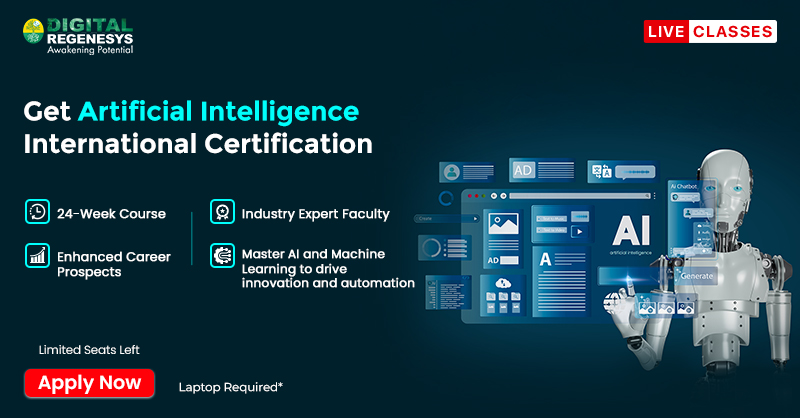
Artificial Intelligence is a transformative skill for professionals across industries, offering the ability to automate processes, generate insights, and make strategic decisions. Online AI courses provide learners with structured, hands-on experience, whether they are beginners or seasoned professionals. The Digital Regenesys Certification Course in Artificial Intelligence is designed progressively to build foundational knowledge and advance learners through practical projects, ensuring a clear learning pathway for all experience levels.
Start your AI journey today and enrol for the course on the Digital Regenesys website to gain industry-relevant skills and career-ready expertise.
A Comprehensive Guide to Online AI Courses – FAQs
Who can enrol in an AI course?
AI courses are suitable for learners of all experience levels, from high school graduates to experienced professionals seeking applied skills.
Do I need programming experience to start learning AI?
Some beginner courses introduce programming, while others assume prior knowledge. The Digital Regenesys course is designed progressively, accommodating both beginners and experienced learners.
What types of online AI courses are available?
Options include short courses and certifications (under 1 year), professional diplomas (12 months), and degree programmes (1–3 years), each offering different depth and focus.
What topics are covered in AI courses?
Core topics include programming (Python/R), machine learning, data analysis, deep learning, natural language processing, AI ethics, and practical projects.
How do I choose the right AI course?
Consider your career goals, prior experience, practical vs theoretical focus, course accreditation, and flexibility of delivery format.
Leave a Reply